Author: Chastity White Rose

  • Chapter 8: Too Long Didn’t Read

    There will be many people who did not make it past even the first chapter of this book. This book about Chess is necessarily long because I am sharing all the information I possibly can from my years of experience playing Chess and games similar to Chess. At this point, you might be thinking, “This book is too long! I am not going to read all this!” And you would not be the first to think like this.

    The truth is that most people, especially in these modern times no longer have the time nor patience to get as deep into Chess as I have. This world is built around a system of instant gratification as people are bombarded with advertising about movies, toys, First Person Shooter video games, and sex. Most people never dedicate their lives to anything with much devotion. They have short attention spans, and they want to feel happy and feel it NOW.

    And I think that is what is wrong with the world. I don’t just promote Chess because it is a board game that I happen to enjoy and am pretty good at. I think Chess is actually good for the world. Although you will probably not take the time to read this, I have compiled a list of the benefits of Chess and why I have such loyalty to an ancient board game that almost nobody will play with me outside of nerds on the internet.

    1. Chess teaches people to think before they act. Relying on impulse or your first guess is almost certainly wrong. We could all use a little more hesitation in all of our decisions. A person who moves without looking at all the pieces on the board will make huge mistakes. Chess reminds you to look at your surroundings and think of the cause and effect that could take place.

    2. Chess teaches you to understand the mind of your opponent. By trying to anticipate what moves your opponent is planning, you are entering their thought process. Many times, I have come to respect someone’s intelligence based entirely on how I see them play Chess. It is the one game where someone’s thought process is evident. Chess is not like Monopoly, where a lucky dice roll can make someone win without really knowing how to play the game. The process of winning is much more satisfying in Chess because you know that you actually outwitted your opponent.

    3. Chess is entirely free to play. Although there are many computer programs that you can buy, the original form of Chess is a board game. If you first buy a Chess set, or someone gives you one, you can play with your friends or even play against yourself. There is no limit to how many games you can play. You could play once a week against your friend or you might be obsessed and have played over 5,000 Chess games online like I have. Because there is no punishment or reward for winning or losing, you do it as much as you want, when you want, limited only by your goals.

    4. Chess is a game of equality. Race, gender, financial status, religion, or political affiliation have nothing to do with Chess. Being in one category or another does not make you win or lose. It is the one game where you can be considered a loser by society’s constantly changing standards, but you can still win at Chess against someone who is too overconfident and doesn’t have the intelligence to stop you.

    5. Learning Chess is easy. Learning to play Chess is really not hard. Chapter 1 covered all the rules that you need to know. A person can begin playing Chess and even win a few games on the same day. It’s not nearly as hard as learning to play most other board, card, or video games.

    6. Chess is tough to master. Although it may be easy to learn the rules, getting experienced enough to win 75% or more of the time can take years. By constantly playing and training yourself to avoid mistakes, you can improve. Most people simply don’t have this much time, nor are they willing to sacrifice other things in their lives that they spend time doing. But I honestly think that if Chess were easy to master, then I would have already achieved everything I could do, and then the fun would be over. Chess provides me with enough challenge that I never get bored.

    7. Chess can help you make friends. Many people are not physically inclined for other activities. Some of them can’t play sports or participate in what is popular for most people. However, Chess is something that many people can find community in. There are groups, Chess clubs, meetups, and no shortage of online websites, such as lichess.org. Over time, you might meet people who can become good friends over a shared activity like Chess or whatever else you may have in common.

    8. Chess is also a game for the solitary. There are hermits like me who can spend much time alone and meditate on the possible moves that can be made. The fact that I can play Chess against a computer when no human is available allows me to test my mind against the artificial intelligence of Chess engines like Stockfish. Chess can help you be social when you want to, but it does not require it if you would rather be left alone. I sometimes play entire Chess games in my head because it brings me comfort for something to make sense when life can be so unpredictable.

    If you have made it this far, you can consider yourself above average. Although anyone can play Chess, not everyone sees the beauty of it like I do. My hope is that because I wrote this book, there will be at least one person who has never heard of Chess but comes to learn to play and understand the joy of Chess as much as I have.

    If my writing causes even one person to find happiness or relaxation by playing Chess, then I have succeeded in my mission. If you are that person, please let me know.

    Chapter 9: The Making of the Paperback

  • Chapter 7: The Value of Chess Notation

    As I have said before, you don’t have to learn Chess notation in order to play Chess. You could even be a Grandmaster without learning Chess notation. However, learning Chess notation does have some benefits that you should know about.

    1. If you know Chess notation, you can write down any sequence of moves on paper that you play over the board. If this information is not written down, you will probably forget what happened in the game and why you won or lost. This is extremely frustrating for someone who wants to improve.

    2. Most Chess websites will automatically keep track of the notation for you. In fact it is quite possible to look at the notation and figure out what it means because it is very simple.

    Names of the Squares

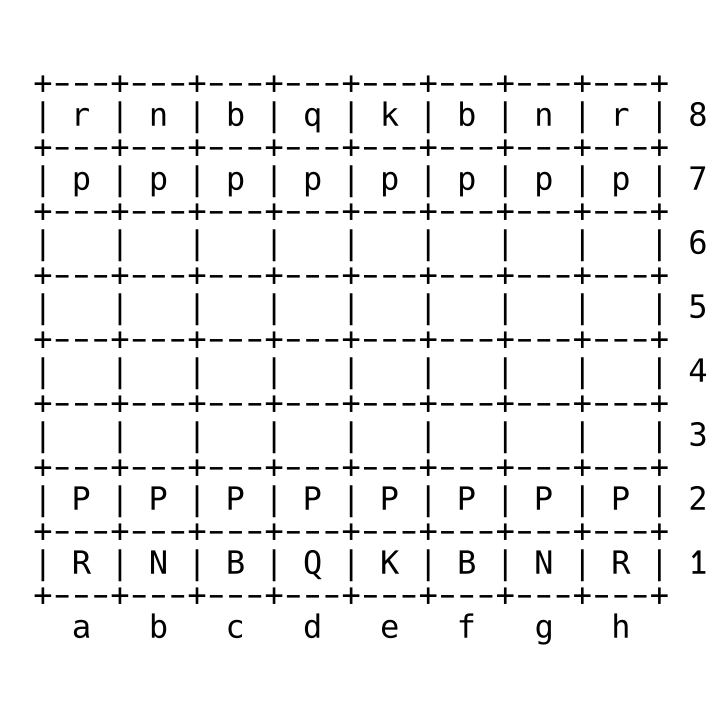
    If you are viewing the board from the white player’s perspective, the names of the squares are as shown in the following picture.

    Chess_Coordinates_White.png

    The letters are called files and the numbers are called ranks. If you are familiar with the name of the squares, then you can know what piece starts on that square and where it can move. For example, the white queen will start on d1 and the black queen will start on be on d8. The kings are on the e file instead of the d file. The 8 white pawns are on rank 2 and the black pawns are on rank 7.

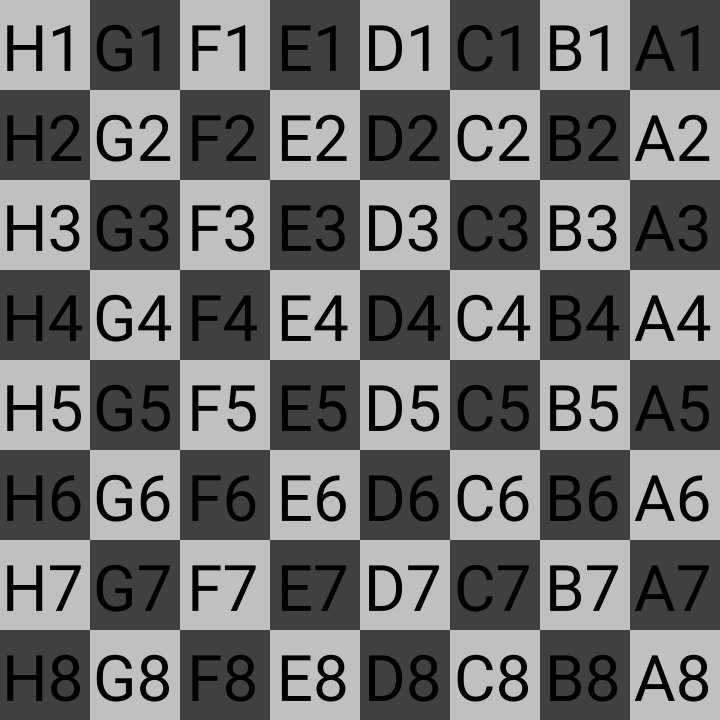
    However, if you are the black player, you will have to remember that the view is flipped from the previous image. This means that all your major pieces are along rank 8 instead of rank 1.

    chess_coordinates_black.png

    Many Chess boards have the letters and numbers printed on the sides of the board to help people remember the names of the squares by reading it like a map.

    If learning the names of the squares is too much for you, just remember that it’s not required. However, if you understand the names of the squares, then you can write down from the beginning of the game where a piece moves. For example, if white moved their knight from g1 to f3, then the notation would be written as “Nf3”.

    Letters of the Pieces

    Each Chess piece, except for pawns, is represented by a letter.

    K = King
    Q = Queen
    N = kNight (second letter used because K is already used for King)
    B = Bishop
    R = Rook
    

    Pawns moves are simply written as the name of the square the pawn moved to.

    If a piece moves to a square at the same time as capturing something already on that square, then you add an x to the notation For example, if the notation says

    1. d4 d5 2. c4 dxc4
    

    Then we know that we have reached the Queen’s Gambit Accepted position as described in chapter 2. Black has captured the pawn on c4 that white was trying to sacrifice.

    Suppose that a pawn gets all the way to the other side and promotes to a queen. Then the notation would be

    d8=Q
    

    If any move results in putting the king in check, we add a plus sign to that move. For example if white’s bishop were to capture the pawn on f7 and put the black king in check, it would be written as

    Bxf7+
    

    Once you know how to write the notation for the moves, it is possible to record any Chess game and even make notes for yourself. This is especially helpful in Correspondence games. Of course most people don’t write the notation because we have computers to do it for us. I think the main benefit of learning Chess notation is being able to read it.

    For example, consider the following notation:

    1. f3 e5 2. g4 Qh4#
    

    If you play those moves on the board or in your head, you will get something that looks like this picture of the fool’s mate from chapter 1.

    Chess_Checkmate_Example_2.png

    The # is the symbol for a checkmate, the check where there is no escape for the king. If you are searching a large text file database of games, you can conveniently search for this character to find the games that ended in a checkmate to separate them from games that ended because somebody gave up and resigned.

    As someone who plays a lot of online Chess, I accidentally became fluent in Chess notation because I read the notation as I play the games and see it written on the side. As a result, I often speak in Chess notation to describe moves while playing with people.

    Unfortunately, people don’t know what I am talking about. For this reason, I felt like it was necessary to at least include this chapter which serves as a basic introduction. Other Chess games have their own notation. For example, Shogi notation is often written in Japanese and Xiangqi notation is written in Chinese. I can’t read their notation systems at all but there are westernized versions of them as well.

    A person can also make up their own notation entirely. If you can think of a better system to help you remember what moves you made, then it’s not wrong as long as it helps you.

  • Chastity’s SVG Set for Chinese Chess Set A.K.A. Xiangqi

    I had previously made my own custom designs of the board for Standard Chess and Shogi, but I had not yet completed the Xiangqi board. I finally completed my Scalable Vector Graphics set for Xiangqi which is known as Chinese Chess.

    This is modeled after the way an Xiangqi board is meant to look. However, I took special effort to make sure that this board and pieces fits within a 720×720 square area. Of course, since I made the SVG file in Inkscape, it can be scaled to whatever size the user wants. The Chinese Chess board is a little bit more complex than it is for Westen Chess or Japanese Chess (Shogi).

  • Chess and Solitaire

    Could there be a connection between Chess and Solitaire? I have never written about this before, but I was obsessed with Solitaire in my teen years. At first it was Klondike, Spider, and Freecell because they were included on Windows XP.

    When I switched to Linux, I looked for open-source versions of it. The PySol Fan Club Edition had the largest collection of Solitaire games I have ever seen.

    But you might be wondering what this has to do with Chess. At the same time that I was playing Solitaire, I was also playing Chess a lot. When I discovered PySol, I was so into the cards that I bought a physical deck and started playing solitaire games and trying to invent my own.

    The fact that I got this far into Solitaire is evidence of my tendency to completely hyper-focus on a special interest. I was even designing new playing cards by editing the SVG files included in PySol. Ironically, this is the only game I designed art for besides Chess.

    But what reminded me of Solitaire recently was actually Raid Shadow Legends. They added Alice from Alice in Wonderland to the game, except they turned her into a Warrior Goth Girl with the Vorpal Sword and the most incredible outfit, which contains the chessboard and the card suits, from the standard playing card decks.

    Both playing cards and Chess are part of the Alice in Wonderland books and their many spinoffs and adaptations. Much like Alice, I, too, am a dreamer who visits a strange place. I have referenced this in some of my blog posts and songs. I have my version of Wonderland.

    I don’t know why but as I look at the chessboard and the designs on the playing cards, I can feel the power of these ancient symbols used for many games. Every piece, card, and rule has its history of how it came to be what it is today. Perhaps this is why people like me have board and card games as special interests and never seem to get tired of it. Some things have become famous all over the world. I wrote something about Alice after I saw her in Raid Shadow Legends. Once again, I had a moment upon seeing the design of her dress that reminded me of the games I love and why they bring me comfort.

    Alice the Wanderer
    
    Alice had no home in the human world. She preferred the nightmares of Wonderland over the nightmares of Earth. She had become stronger than she ever thought possible. She may not be able to win battles on Earth, but she has conquered the battlefield of her mind. She was not sure whether Wonderland was any more or less real than the world that humans called Earth.
    
    She had come to understand that the Mad Hatter was no more mad than she was. As the Cheshire cat had said, we are all mad here. A world of checkerboards and playing cards brought her comfort because it reminded her that life is a game and a game can be won. 
    
    But who sets the rules of the game? Alice was not sure, but she preferred to make her own rules. Alice makes the way and chooses her own path. In any case, it did not matter where she went. Alice was ready for anything, no matter where she was headed. She did not know where she was going, but she would get somewhere if she walked far enough.

  • Chastity’s Chess Chapters Song Lyrics

    Chastity’s Chess Chapters

    I was trying to inspire people to play chess
    My plans were good, but the execution was a mess
    If people don’t know how to start
    Then they will never know that chess is art

    I decided to write my own chess book
    With large pictures for people to take a look
    The new player needs some motivation
    Before they even know chess notation

    My graphic design was quite berserk
    Most of my time was spent on artwork
    They needed to be the right size
    I failed so many of my tries

    I never give up because I am a nerd
    I put my heart into every single word
    I want my readers to understand
    The vision of chess that I have planned

    Because chess is not hard to learn
    As long as you do not rush your turn
    It’s not a game for the strong or fast
    But for the patient who can outlast

    With every piece that you take
    You question if you made a mistake
    The book I write will not misleed
    But you need the patience to read

    If there is something I should show
    Then message me and let me know
    The game of chess should always be free
    If you take the time, I know you will agree

  • Chapter 6: How to Improve at Chess

    In this chapter, I give some advice that I believe will help players improve.

    The Meaning of Chess Ratings

    At some point, a Chess player will notice the numbers of their rating or their opponents on Chess websites. The ELO rating system is a very controversial and confusing tradition, which I believe can lead to problems. To avoid these problems, I want to explain some things.

    When you win a rated game, your rating goes up, and when you lose, your rating goes down. However, the amount by which it changes depends on the rating of your opponent. So, for example, if a 500-rated player beats a 2500-rated player, their rating would go up by a lot more than if they beat a 300.

    But the most important thing is that ratings are only a measurement of how smart of a player you are; they do not represent actual differences in strength or that one player has an unfair advantage. Chess is not like a physical sport where one person is stronger and can always win. The 500 and 2500 player each could win the game theoretically if they outsmart their opponent with the right moves.

    But what I am about to tell you is that players with high ratings are often cowards. They are afraid to play with lower rated players because if they lose, they lose more rating points than if they lose against another player rated closer to their rating.

    I believe this problem comes from the fact that having a high Chess rating is seen as a status symbol for bragging rights. My own opinion is that they are meaningless, however. You don’t have to just take my word for it. I have links to two games to show an example of what I am talking about. The fact that every game in lichess is stored permanently on the server means that anyone in the world can play through it and see how it all happened.

    In this first game, I was rated 1763 but I beat someone rated 1926.

    https://lichess.org/lz2BBrn2

    If you browse through that game, you will see that they allowed me to fork their king and queen at the same time, and I captured their queen and then proceeded to checkmate them in a few moves after that.

    In the second game, I was rated 1913, but my opponent got a pawn to the other side and checkmated me with the new queen. I also made several mistakes, like allowing their bishop to fork both my rooks at the same time.

    https://lichess.org/5tnccreY

    Basically, the takeaway from this is that I go into each game knowing that I can theoretically win. Both sides have the same pieces at the start, and the only difference between me and my opponent is the moves we decide to make. I don’t take Chess ratings seriously at all.

    That being said, as a player naturally improves and makes fewer mistakes, their rating will probably rise accidentally! So ignore what your opponent’s rating is and instead look at where all their pieces are! That is what you should focus on. Do not be psychologically intimidated by what ratings you see.

    Keep a Database

    One of the benefits of lichess is that every single game is stored on their website. Also, it is possible to export all of your games into a text file and then analyze it with the software of your choice, including those that I mentioned in Chapter 4.

    By downloading the database and loading it into software like ChessX or En-Croissant, you can see how often you are winning or losing with certain openings and see what moves you might be making that cost you the game. Keeping and studying a database of your games is the single most awesome way that you can learn from your losses and be encouraged by your past wins as well.

    Take Notes

    Normally, a person cannot take notes during a chess game. In fact, it might be considered cheating in over-the-board tournaments. However, something that can be done is to take notes during correspondence games. Sometimes, you have to wait a few days before your opponent takes their turn. When this happens, you may totally forget what moves you planned to respond with when they captured that bishop or knight you sacrificed to set up a trap.

    Writing things down on paper or perhaps digitally on your phone or computer, which you normally use to play online Chess, can be a really good idea. It will keep you organized because correspondence Chess is harder on the brain than ordinary classical Chess. However, I find the lack of time limit to be quite relaxing. Having a ticking clock during live games can distract my eyes from the board and lead to mistakes. Therefore I recommend taking notes and trying correspondence instead if you also have this same problem.

    These notes can also be useful for planning your future games as well. If something worked well for you in a game, maybe try that same technique in the next game. If you don’t write it down, you will probably forget!

    If you are looking for a good application to take notes on for PC, iPhone, or Android, I highly recommend Joplin. It allows you to take notes and organize them by folders or tags. Using Joplin could be useful for making a personal database of Chess games by tagging them according to wins, losses, and draws, as well as reasons for why the games were won or lost. Was it a checkmate or a resignation?

    If you are the writer, you can include as much or as little information as you want. One of the reasons I recommend installing the Joplin app over just having a bunch of text files on the computer is that my poor memory means that I can’t remember where the files on my computer are. Having the notes in Joplin means that I can type in a search and find what I am looking for instantly!

    But the most important thing is that no matter what tools you use, you are in charge of your Chess improvement. You can do it according to your style and enjoy the journey.

    But remember, if you ever want a real person to help analyze your games from a human perspective, you can always ask me! I love to stream and record videos about Chess just for fun. I will gladly analyze your games, and you only need to ask!

    And the best part is, I don’t charge money. I just want people to play Chess with me. That is why I must teach them the ancient ways of this game!

  • Chapter 5: The Best Chess Websites

    There are more websites to play Chess on than you can possibly imagine. However, only a few of them support variants beyond just standard Chess. In Chapter 2, I mentioned Crazyhouse, Atomic, Shogi, and Xiangqi. These are only 4 out of hundreds of variants. In this chapter, I will go over the top websites that I play on regularly and which variants I usually play on those sites.

    Lichess.org

    lichess is the first website you will want to visit and create an account if learning Standard Chess and variants based directly off of it. It supports Chess960, Crazyhouse, Atomic, Three-Check, AntiChess, King of the Hill, Horde, and Racing Kings. This is more than most people can master.

    It’s also important to mention that the site is entirely free and made with open source software. This is a big deal philosophically for me and for many other people who do not like the corruption of big companies that try to claim ownership over what can be done with a game. The site is financially funded by people who voluntarily donate because they want to help keep the developers paid and keep the site hosted, which is probably not easy considering that it manages billions of Chess games every month!

    Lichess is the second most popular Chess website in the world. Chess.com is still number one but it does not support all the variants that Lichess does. It also does not allow correspondence Chess for anything besides Standard Chess or Chess960. Because I like Crazyhouse the most, I started playing on lichess almost exclusively.

    Lishogi.org

    Just as Lichess is built around Standard Chess and a few variants, lishogi is a fork of Lichess with everything changed to be about Shogi, which is the name for Japanese Chess. You will find that Shogi is even harder to master than Standard Chess and there are a lot more rules to remember, especially when it comes to promotion of pieces that reach the other side. The goal may still be to checkmate the king, but it is still a different game than Standard Chess. However, if you have played Crazyhouse Chess and you enjoy dropping captured pieces back on the board, I can’t recommend a better site than lishogi. It also has variants of Shogi that I haven’t even learned how to play.

    Pychess.org

    pychess has more variants than any other site mentioned in this chapter. However, there are 4 variants that I particularly play on there than I must recommend.

    Duck Chess

    Just like Chess, except that there is also a duck! I know it sounds insane but this is one of the funniest but also most challenging variants. There is only one duck but after each player makes their regular Chess move, they are required to move the duck to a new empty square ANYWHERE on the board. The duck cannot capture anything but it also cannot be captured or moved through. This means that the duck can block even a checkmate temporarily if no other pieces can stop it.

    Grand Chess

    Grand Chess is played on a 10×10 board and has two new pieces in addition to the standard chess pieces. The cardinal moves like a Bishop and a Knight. The Marshal moves like a Rook and a Knight. If you think about the fact that the Queen in Chess is like a combined Bishop and Rook, these piece combinations really don’t seem unusual. Even so, pychess is one of the few sites you can play this variant on.

    Fog of War

    In this variant, players cannot see their opponents pieces unless they have a piece that can legally move to that square. This variant is unique to playing on a computer because there is no way to simulate this experience on a regular chessboard that I can think of.

    Alice Chess

    Alice Chess is a variant based on “Through the Looking-Glass” by Lewis Carroll. The game involves pieces moving between two different Chess boards or perhaps opposite sides of a single chessboard made of glass in the way that Pychess renders it on the site. I am really bad at this variant but because I am a fan of the Alice in Wonderland series, I think it is worth exploring more in detail and eventually I shall master it!

    pychess-alternates.onrender.com

    The pychess_alternates website is an alternate site for Pychess.org users which has more variants that have not been merged into the main site. I have to recommend it because it has two games not available anywhere else!

    Coffeehouse

    Just like Crazyhouse except that captures are mandatory. If you can take an opponents piece, you are forced to even if it is a bad idea. I am bad at this variant but I love playing it and can never get enough people to play with because few people know the site exists…

    Coffee Shogi

    Just like Coffeehouse except that it is based on Shogi instead of Standard Chess. This is probably the most psychologically challenging Chess variant that I have ever played! If nothing else, this would make the site worth a visit for the serious player who doesn’t think Shogi is hard enough!

    Those are only two of the variants that are only available on that site. However, few people know about the site because it isn’t talked about much. I only know about it because it was mentioned in a Pychess blog post.

    playstrategy.org

    Playstrategy has a lot more than Chess and its variants. It also has Draughts, which is usually called Checkers in America, and Go, another really popular board game in Japan. I visit this site specifically to play those games even though it also has Chess, Shogi, and Xiangqi.

    chessvariants.com

    The chessvariants site is a great resource for learning about the rules of Chess variants that you have probably never heard of. Usually lichess and Pychess do a good summary of the rules and can be accessed directly on their site, but chessvariants can tell you a lot more information about the variants including their history which is useful for nerds like me. I don’t just want to play the games, I want to know everything about them too.

    Other sites

    Chess.com is usually the first site where people begin playing online Chess. Although lichess.org is better in my opinion, chess.com existed before lichess.org and has even more users. There is nothing to stop people from playing on both sites and see which they like better.

    Xiangqi.com is probably the best resource for learning about Chinese Chess for a new player. I prefer playing on Pychess.org but that’s because I already know how to play and because Pychess supports correspondence games which fit into my busy lifestyle better. But if you want to get a quick real time game of Xiangqi, then Xiangqi.com has the most users who are specifically looking to play this variant which is popular in China.

    Chapter 6: How to Improve at Chess

  • Chapter 4: Chess Software

    In this Chapter, I will go over the best Free and Open Source software that is available for either playing or analyzing Chess. There are two command-line Chess Engines that I will recommend, two Graphical User Interface Programs that can use those engines, and two more utility programs that are specifically about managing Chess databases. Finally, I will mention how you can use these tools to analyze the games you have played.

    Stockfish

    I will not be covering how to install Stockfish because that is a separate matter, depending on your operating system. However, I will explain how Stockfish can be used from the command line once it is downloaded and placed in your path.

    However, you can easily download Stockfish and find a detailed guide for installing it on your platform.

    Usage at the command line

    Although the official stockfish documentation is very good at helping people to set up Stockfish with most GUI software, there is a way to play directly by running commands from a terminal or command prompt.

    After downloading and installing the engine by whatever means you used, just type “stockfish” at the command line or adjust the name to whatever your executable is named
    You will probably see a message similar to “Stockfish 17 by the Stockfish developers (see AUTHORS file)”.

    Simply type d and press enter. You will probably get something like this:

    That is because d is the display command and it will show a text representation of the Chess board. The position can be changed with a certain format. For example

    position startpos moves d2d4

    Will move the pawn from d2 to d4. This is my favorite starting move. So if you use the d command again. You will see that the pawn has now moved!

    Now that we have made our first move as white, we need to tell the computer to search for a move to reply with. For that we can enter go depth 1 and it will come up with a quick response. For example if we get the result “bestmove d7d5”. This means that the engine has decided that moving black’s Queen pawn is the best move. So we add this result to the end of our last command.

    position startpos moves d2d4 d7d5

    As you can see, both pawns have moved. However, this is not the preferred way for most people to use the engine. However, I did this as an example to show you what a Chess GUI has to do behind the scene to operate the engine and get back moves from it.

    Fairy Stockfish

    I would like to mention briefly that Fairy-Stockfish is a version of Stockfish that support all of the Chess variants available on lichess.org and even more. I have not mastered the use of it from the command line, but I have confirmed that it works with Xboard, which is the next program I am recommending.

    Xboard

    You can use XBoard/WinBoard to run not only Stockfish, but many other Chess engines that are less popular. I find the interface of the program to be a little bit confusing. However, I have created convenient commands to use which allow me to play Chess, Shogi, or Xiangqi with it on my Windows 11 laptop.

    winboard -fcp "C:\stockfish\fairy-stockfish.exe" -variant normal -xclock -depth 1

    winboard -fcp "C:\stockfish\fairy-stockfish.exe" -variant shogi -xclock -depth 1

    winboard -fcp "C:\stockfish\fairy-stockfish.exe" -variant xiangqi -xclock -depth 1

    If you are playing XBoard, the Linux version, you can change winboard to xboard and change the path of fairy-stockfish to wherever you have it installed.

    Although I have less experience using Xboard than the other recommended software in this book, XBoard when combined with Fairy Stockfish allows you to play more types of Chess Variants than any other program that I know about.

    Also, if you beat Fairy Stockfish at depth 1 using commands similar to the above, then try changing that number to something higher and then then the computer will search deeper and find even better moves to play against you. Beating it at full strength is impossible for a human player.

    En Croissant

    I recommend En Croissant for people who are only interested in playing standard Chess and want to analyze the games they have played on lichess.org or chess.com. It has a feature which can download all the rated games of a username of a player on those sites specifically. This means that if you play online on these sites, you can instantly obtain a database of your own games. You can use this to see how often you win or lose and what mistakes you are making.

    It also allows you to download larger databases of games like Caissabase which are full of games from the top Chess Masters of the world. This allows you to see how really good Chess players can play and maybe learn some things from them! That’s what I try to do!

    pgn-extract

    Once you have a database of your own games, or perhaps games of other people, you may want to filter them by certain criteria. The program pgn-extract is exactly what you can do this with. It is a command line only program. You will have to read the documentation to know all of its options but here are some commands that I commonly use to keep track of my best wins.

    These commands use the file “lichess_chastitywhiterose.pgn” which I downloaded directly from lichess.org. There is a built in export feature that allows you to select games of different time controls and/or variants and decide which ones to export to pgn file. pgn-extract can only handle standard chess games but it can sort them extremely fast. For example

    This first command takes all of the games where chastitywhiterose was the white player and won the game by checkmate.

    pgn-extract -Twchastitywhiterose -Tr1-0 lichess_chastitywhiterose.pgn -ochastitywhiterose_white_wins_lichess.pgn --checkmate

    The second does the reverse and finds every time that chastitywhiterose played as black and then black won the game by checkmate.

    pgn-extract -Tbchastitywhiterose -Tr0-1 lichess_chastitywhiterose.pgn -ochastitywhiterose_black_wins_lichess.pgn --checkmate

    I have said for years that only games ending in a checkmate are reliable information. If you opponent timed out because they fell asleep or got distracted, that doesn’t really feel like a win does it?

    ChessX

    The best currently available free and open source Chess database management program is ChessX. It allows you to open a pgn file and actually play through all the games with a graphical user interface. This is the best way to analyze your games and see visually where you made the mistakes. I have not full explored everything that the program can do but I read that it also has filtering capabilities similar to what you could have done with pgn-extract which I previously mentioned.

    Possible Updates

    I know there are infinitely more open-source Chess related programs out there that I have not had time to use or write about. If you know of any really good programs that are also open source, let me know and I can probably include them the next time I update this chapter!

    Chapter 5: The Best Chess websites

  • The Horse

    Daily writing prompt
    Which animal would you compare yourself to and why?

    As I have mentioned before, the horse is my favorite animal. This is because horses are herbivores and therefore automatically vegan by accident. They are also one of the strongest animals on earth.

    I wish to be as strong as possible but not use my strength to hurt anyone. For me the horse represents a new ideal to aspire to. I used to admire strong men but because humans do not behave like horses, the strength of a man is often used to hurt women and children. Therefore, when I see a strong man, I wonder if he will hurt me.

    But when I see a strong horse, I know that they will not hurt me. Horses have never killed anyone unless that person has threatened or scared them. They are not evil like humans who kill for reasons of religion, politics, financial gain, or prejudice against a certain group of people. Correct me if I am wrong on this but I have never known a malicious horse.

    The horse is also the only animal that is in the game of Chess. Originally it was called Ashva, the Indian word for horse.

    In the ancient game of Chaturanga(the orgin of all Chess type games), there was also the Gaja(the elephant). Both horses and elephants are extremely strong animals.

    I am a horse because I am strong, I eat plants, and I use the horse to jump around on the chessboard.

    It’s also important to consider that the Unicorn is a special type of magical horse. There are even a few Chess variants that include the Unicorn as a Chess piece. I may cover these in a future post!

  • Chapter 3: Chess variants

    As if learning standard Chess wasn’t enough fun, there are historical and modern variants of Chess. I can’t cover them all because there are literally hundreds. What I can do is tell you about some of my favorites and how they differ from Standard/Western Chess as described by most of this book.

    Crazyhouse

    Crazyhouse is a variant available on lichess where captured pieces are not simply gone from the board but instead convert to the color of the player who captured them to be dropped back on the board at a later turn! As you might guess, games in this variant tend to be longer because it is possible to escape a checkmate what you could not get out of in standard Chess.

    There are some special rules that you should be aware of.

    • Drops resulting in immediate checkmate are permitted.
    • Pawns may not be dropped on the players’ 1st or 8th ranks.
    • Promoted but captured pawns are dropped as pawns.

    The notation for Crazyhouse is the same as Chess except for the addition of the @ symbol to say that a previously captured piece is dropped back on the board.

    For example, consider the position of the Queen’s Gambit Declined from the previous chapter.

    d4-d5-c4-e6.png

    In this position, white decides to capture the d5 pawn with the c4 pawn.

    1. d4 d5 2. c4 e6 3. cxd5.png

    Next, black tried to put white’s king in check by moving bishop to b4.

    1. d4 d5 2. c4 e6 3. cxd5 Bb4+.png

    If this were regular Chess, white would not be able to move the king and would have to put a bishop or knight in the way to block the check. However, white previously captured a pawn and so they can drop one to the c3 square.

    1. d4 d5 2. c4 e6 3. cxd5 Bb4+ 4. @c3.png

    This means that the bishop is on the run and white has 9 pawns on the board. The situation is already looking like it will lead to a win for white.

    Atomic

    Another variant which is available on lichess is Atomic. In this game, whenever a piece is captured, it creates an explosion that blows up the surrounding 8 squares! However, pawns on those 8 squares do not explode for some reason. They must be made of Minecraft obsidian or something like that. However, when a pawn makes a capture, it does explode. For example, the following position shows that white has moved their king’s pawn two squares and black has moved their queen’s pawn two squares.

    1. e4 d5.png

    White can capture, however, when it does, both pawns disappear!

    1. e4 d5 2. exd5.png

    And now that there is nothing in the path of the black queen, they capture the d2 pawn and blow up white’s king, queen, and bishop because all of them were on the adjacent squares to the d2 pawn.

    1. e4 d5 2. exd5 Qxd2.png

    Black’s queen is also gone but black has already won this game of atomic chess! The king wasn’t just checkmated, it was actually destroyed in an explosion!

    So as you can see, atomic games don’t last very long because it doesn’t take many moves before pieces are destroyed. That doesn’t mean it is simple to win it though because I am not very good at it despite my experience in normal Chess. Still, it is my second favorite variant of standard Chess, right behind Crazyhouse!

    But there are more Chess variants available on other websites. Some of them are very different from the standard Chess but they have many things in common.

    Shogi

    For example, let me show you the board for Japanese Chess, which goes by the official name of Shogi!

    Chastity SVG Kanji Shogi Set.png

    It looks very fancy but unless you can read Japanese, these symbols probably make no sense to you. I can read them because I am experienced at playing Shogi enough in apps that force me to read their pieces. But for most people, the following image will make more sense.

    Chastity SVG Western Shogi Set.png

    Shogi is very much like Chess despite the difference in appearance. Shogi has pawns, kings, rooks, bishops, and knights. However, their some of their rules for movement are slightly different. However, the rook, bishop, and king are still identical to Western Chess.

    But there are new pieces, the Lance, the Silver General, and the Gold General. You need a tutorial on Shogi to learn how to play it. I may consider writing a tutorial later on but I have also been known to record videos on it and demonstrate how I play.

    Also, you can play Shogi anytime on lishogi.org. It allows you to choose either the traditional Japanese pieces like the first picture or the westernized pieces from the second picture.

    Xiangqi

    After you learn Chess and Shogi, I recommend Chinese Chess known as Xiangqi. You can learn and play it on xiangqi.com. Usually the game is played with pieces represented by Chinese Characters. However, many sites and programs allow you to select a westernized set similar to what was available for Shogi.

    chastity-svg-xiangqi-set.png

    You will find that Xiangqi is harder to learn because there are different rules for pawn movement depending on whether they have crossed the river. The game also has elephants which move two spaces diagonally but can never cross to the other side of the river. Because of this, you will find that the rooks, knights, and cannons are the important pieces.

    Cannons are actually one of the more bizarre pieces because nothing quite like them exists in Chess or Shogi. They move like a rook but cannot capture unless there is a piece in the way to jump over!

    I like Xiangqi almost as much as Chess and Shogi, but I am really bad it Xiangqi and I always lose because I am usually playing online against Chinese people who actually know how to play it well!

    After you learn the rules of Xiangqi, then you might want to play it on pychess. Pychess supports Chess, Shogi, and Xiangqi. It is probably the best site if you want to play the most variants possible.

    In the next chapter, I will be listing websites and which Chess variants they allow you to play. This chapter was merely a brief introduction so that you know that other games like Chess exist! I could never list them all, but I recommend at least learning Chess, Shogi, and Xiangqi. Once you know these three, then all other Chess variants will have similar rules to at least one of them.